Microsoft Purview in Finland: Legal and Regulatory Notes Before Rollout
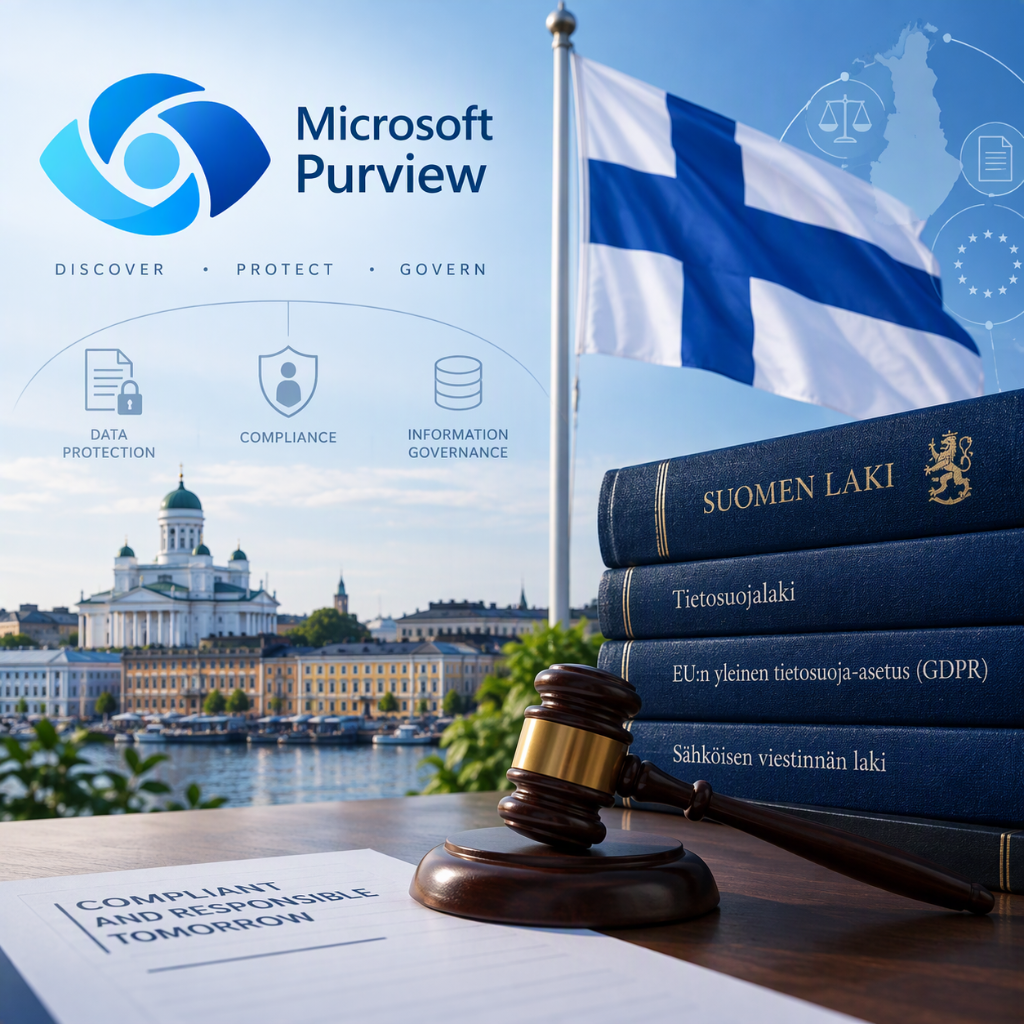
I already mentioned in the pre-implementation post that Microsoft Purview rollout can become a legal and employment-context question very quickly in Finland. I think that note deserves a standalone companion because it is too easy to wave at “GDPR stuff” and then move on as if the local details are minor. This topic deserves a separate think through as I am based in Finland and is an interesting one as well as a needed one if implementing Purview here.
The same steps are needed for Defender roll-out by the way ;)
They are not minor.
This post is a companion to my practical Microsoft Purview implementation series, not a numbered part of it. The purpose is to explain why Finnish legal and regulatory context should be checked before rollout, especially when the implementation touches employee data, monitoring, investigations, communication review, or large-scale processing of personal data.
Skip to the good part
- Why Finland deserves a separate note
- The baseline legal frame
- Why employee-data scenarios need extra care
- What this means for common Purview features
- A practical review checklist
- Conclusion
Why Finland deserves a separate note
Microsoft Purview often gets sold or discussed like a control platform first and a legal platform second. I think that is backward in some of the more sensitive scenarios.
If you are enabling features that inspect, classify, retain, monitor, investigate, or escalate activity around personal data, then your local legal context matters before the rollout, not after it. That is especially true when employee information or internal communications are involved.
Finland is not outside the GDPR, obviously, but it also is not only the GDPR. The Office of the Data Protection Ombudsman states that Finland’s Data Protection Act supplements the GDPR and that Finland also has specific legislation for certain processing situations, including the Act on the Protection of Privacy in Working Life. Data protection legislation is the key official reference there.
That alone is enough reason not to treat a Purview rollout as only a portal project.
The baseline legal frame
The Finnish Data Protection Ombudsman’s guidance is useful because it stays focused on controller obligations instead of marketing language.
The core messages are fairly clear:
- the GDPR applies when personal data is processed
- Finland’s Data Protection Act supplements the GDPR
- controllers must be able to demonstrate compliance
- risk assessment and data protection planning are expected before processing, not after trouble appears
- transparency toward data subjects matters
- processor relationships must be documented properly when another party processes data on the controller’s behalf
The relevant official pages I would keep in view are:
- Data protection legislation
- Processing of personal data
- Risk assessment and data protection planning
- Demonstrate your compliance with data protection regulations
- Inform data subjects about processing
- Processors
I am not listing those to sound thorough. I am listing them because they map directly to rollout decisions in Purview.
Why employee-data scenarios need extra care
The Data Protection Ombudsman’s legislation page explicitly notes that Finland has specific legislation including the Act on the Protection of Privacy in Working Life. That is the point where many Microsoft Purview discussions stop being generic compliance planning and start becoming employment-context planning.
I think the practical lesson is simple: if the feature touches employee monitoring, investigations, communication review, or broad inspection of employee-generated content, involve legal and HR before configuration work goes too far.
That does not automatically mean the feature cannot be used. It means the legal basis, purpose limitation, transparency, safeguards, and operating model need proper review. This review means DPIA or Data Processing Impact Assessment as well as possible co-operations negoitations in the organization. From these two, especially the latter can be a process that brings Purview implementation to a halt as it is quite heavy.
There might be a situation where co-operations negotiations have taken place as part of Defender roll-out and some topics handled there might cover Purview workloads as well. The key is that the negotiations need to take place if there is any kind of new handling of employee data.
This matters especially for things like:
- Insider Risk Management
- Communication Compliance
- broad audit review tied to individuals
- content inspection at scale
- retention or investigation workflows involving employee material
If the organization only asks the question after the feature is configured, it is late.
Placeholder visual: Diagram showing Finnish rollout review flow across legal, HR, privacy, security, and Microsoft 365 owners before sensitive Purview features go live. Purpose: Show that sensitive Purview scenarios require a local governance and legal review path before technical rollout.
What this means for common Purview features
I think the easiest way to make this practical is to map the legal note back to typical Purview controls.
For sensitivity labels and DLP:
- check the lawful purpose of large-scale content inspection
- make sure user guidance is clear
- check whether personal data categories and employee-related material create extra review needs
For retention and records:
- validate the legal or regulatory basis for keeping content
- decide who owns deletion and disposition decisions
- make sure lifecycle rules do not quietly conflict with another obligation
For auditing and investigations:
- define who can search what
- define escalation criteria
- define when a control review becomes a formal investigation
- define what documentation is required
For Insider Risk or similar features:
- involve legal and HR before enablement
- review privacy settings and role design carefully
- confirm the operating model is defensible, not just technically possible
For Copilot and AI scenarios:
- treat oversharing and prompt-related exposure as personal data questions where applicable
- confirm that transparency, accountability, and data minimization are being taken seriously
A practical review checklist
Before sensitive Purview controls go live in Finland, I would want someone to be able to answer yes to these questions:
- do we know the processing purpose for this feature (We need it is not a viable option)
- do we know the legal basis (read the point above)
- have we assessed the risk to data subjects
- have we documented the safeguards and responsibilities
- have we checked transparency and notice requirements
- have we defined controller and processor roles properly
- have legal and HR reviewed the sensitive employee-impact scenarios
- have we checked whether sector-specific rules apply on top of the general framework
That is not legal advice. It is just the minimum level of seriousness I would expect before rollout.
Conclusion
I think Microsoft Purview can be very useful in Finland, but only if the implementation respects that the rollout is partly a legal and governance design exercise, not just a technical one. From just a technical point of view, it´s sad that legislation brings us hurdles that slow the implementation of security features and improvements. Technical capabilities evolve rapidly and legislation does not, the attackers won´t think about legislation and uses the available attack paths. The same legislation at the same time requires us to protect the environments from attackers so it´s a bit of a double sided thing.
The practical point is not to become paralyzed. It is to involve the right people early enough that labels, DLP, retention, monitoring, investigations, and AI controls are deployed in a way the organization can actually defend later.
If you want the broader context, start with my earlier post Microsoft Purview: What Is It and Why Do I Need It?. If you are following the implementation series, this companion sits next to Part 0 especially closely because the legal footing should be reviewed before the technical work starts.